Tuesday, June 23, 2015

Shelaidaha Kuthi Bari

                                 
                            Shelaidaha Kuthi Bari 


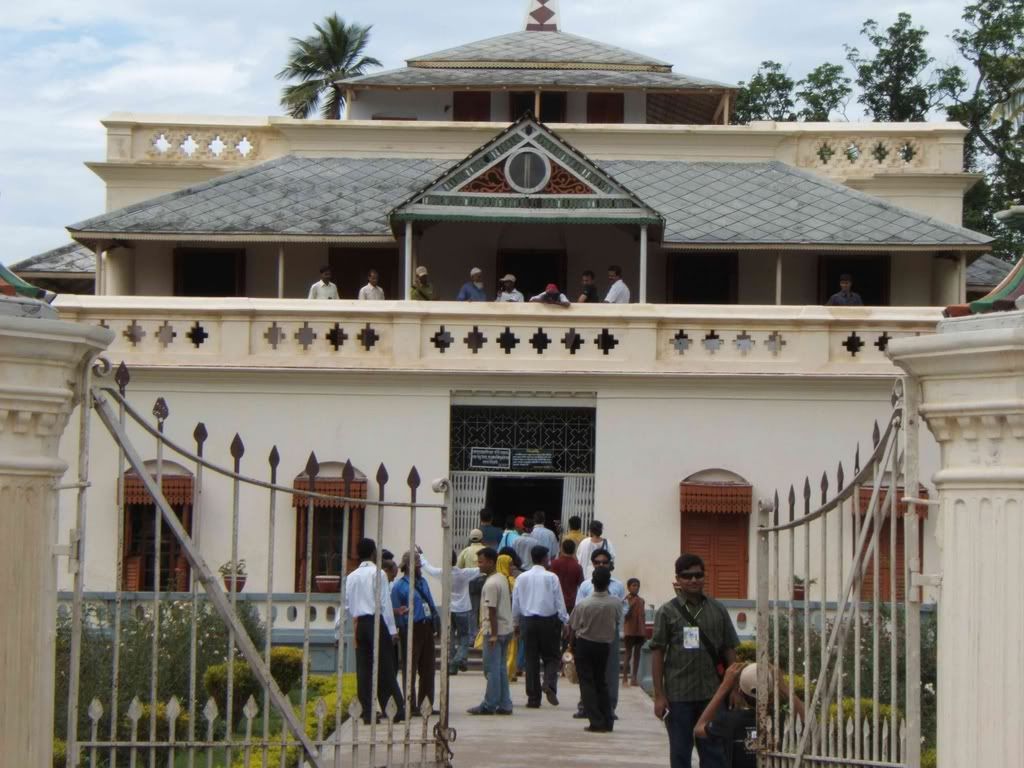
 In 1890 Tagore started managing their family estates in Shelaidaha. He stayed there for over a dacade at irregular intervals between 1891 to 1901. It is a country house build by the father of Rabindranath, Maharshi Debendranath Tagore. The house was repossessed by a Bank; the Tagore Estate was a debtor to this Bank, who auctioned off the property and it became the possession of the Zamindar of Bhagyakul (Munshiganj), Roy family. The house was part of Roy Estate till the Zamindari system was abolished under the East Bengal State Acquisition and Tenancy Act of 1950. Syed Murtaza Ali, during his tenure as Divisional Commissioner of Rajshahi took the initiative to preserve the dilapidated house in 1958. During this renovation, the color of the house was inadvertently changed to red like other houses belonged to the former Zamindars of the district.


Jiyat Kunda


Jiyat Kunda


Of the historic places in Khetlal is Khosh Badan's Mazhar. Hinda Jame Masjid and Harunja Gramer Mazhar are also places of great interest in Khetlal. History reveals the name of Kalu Shah who was a Sufi saint in whose name was built the village of Kahalu.
The Kherua Masjid with three domes and four minarets was built in the year 1582 CE, Bibi Mosque (1628 CE), Khondkar Tola Masjid (1632 CE) was built during the rule of Sher Shah and Shahid Shah Turkhan’s memorial grave (mausoleum), Mosque of Farrukh Siyar, built in the year 1719 CE, are great historic sites.
During 1763 to 1787 CE, Mahasthan became the headquarters of the theatre of the famous Faqir leader Majnoo Shah. For almost twenty years Majnoo Shah was forcing funds out of the treasury of the Zamindars of the villages of Bogra, Dinajpur, Rajshahi, Pabna, Maldah, Coochbihar and Mymensingh. His continuous attack kept the British at Bay. Shah Majnoo built a fort in Mahasthan.
In the year 1765 Pir Fateh Ali came to Bogra. His mazhar is here. Large number of people became his follower (Chalaa) and thus the city took the name of “Chalo” from “Chalaa”, which lies as an ancient city on the eastern side of river Karatoa.
A dedicated Sufi saint named Faqir Abdul Samad initiated building a Jame Masjid in the Tola Mahalla of Sherpur but he had no means to build a Masjid, so he approached Nawab Murad Khan Kakshal. The nawab was a pious Muslim who did not hesitate to come to the assistance of the Sufi. Thus with his help the Masjid was eventually completed. Within 50 yards there are three other Mosques in existence.
The history of Mahasthan as of Bangladesh is marked by ancient traditions of Buddhism, Hinduism and Islam. Over the years superstitions, folklore and mythology has enshrouded the true glory of our past. I have tried to clear up some mist of ignorance and superstition which has crept into our traditions.
The Message of Islam is very simple, clear and unambiguous. I believe that we can revive our past glory by going back to the traits of our forefathers by applying the same zeal of adventure, morality and sense of justice to the new world of technological innovation, investment, creativity, education and enhancement of moral and spiritual values to enhance our quality of life which makes a nation great.
[ I will pause here with a request to others to continue my efforts. Please feel free to correct spellings of names ( I used Bangla names and wrote them in English, hence there is room for error), other facts, names, dates and incidents. I would like to express my gratitude to Janab Shafiqul Alam Saydee Khander, author of the book “Bogura Zillar Otit O Bortoman”]
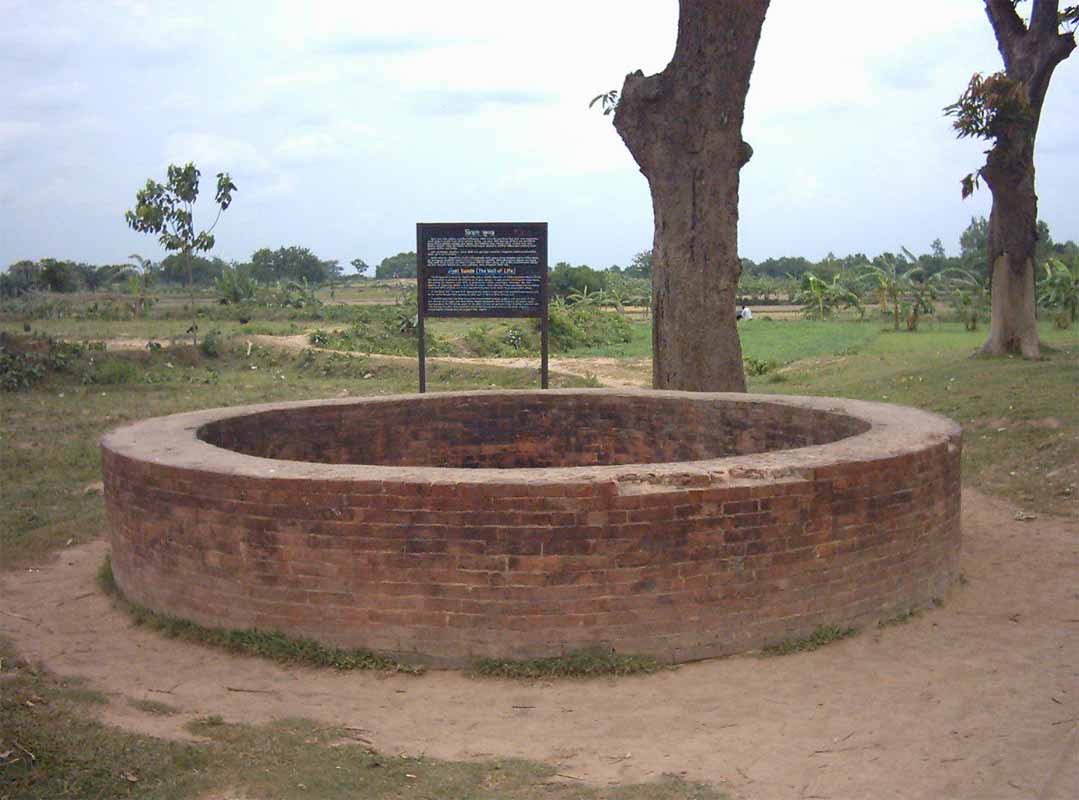
Jiyat Kunda:(the well of life) This 3rd century BC archaeological site in Bogra is still held to be of great sanctity by Hindus
Thursday, June 11, 2015

Pundra Nagar in Bangladesh

Gabinda Vhitta (Situated 185 m north-east of the citadel and opposite the site museum. Base remains of two temples from 3rd century BC to 15th century AD has been discovered.)


Gokul Medh ( Features a terraced podium with 172 rectangular blind cells. It is dated back to 6th-7th century. Local mythology associates it with legendary Lakshmindara-Behula.)

                                                      main boundari of Pundra Nagar

 Bogra a distric in the Rajshahi division . Its called the  gateway to the north Bengal.
It has an important place in the legendary earlier historical annals of Bengal as it was the capital of Ancient Kingdom Pundravardhana (the kingdom of the Pundras). Pundravardhana's history dates back as far as 1280BC. Remains from this ancient kingdom capital still lies in Bogra, now known as Mahasthangarh.
Pundravardhana was one of the kingdoms of Eastern India and was separated by the stream of Karatoya from the more easternly kingdom of Prag-Jyotisha or Kamrupa. The name, Pundravardhana, occurs frequently in the Mahabharata, Ramayana and the various Puranas. According to the Mahabharata and the Puranas, Vasudeva, a powerful prince of the Pundra family, is said to have ruled over Pundravardhana as far back as 1280 B.C. At present Bogra is an industrial city with many small and mid sized industries.

A limestone slab bearing six lines in Prakrit in Brahmi script, discovered in 1931, dates Mahasthangarh to at least 300BC and indicates it was part of the Mauryan empire during 300B.C – 200B.C. Northern Black Polished Ware potteries, Terracotta Figurines and punch-marked coins attests close relations with the Ganges Valley. Besides, a bronze mirror and other objects provide evidence of contacts with North-West India.

Large houses with tile-roofing were uncovered in the Eastern area, together with a large number of finely decorated terracotta figurines. Other findings indicate that the city had a vast suburb around it. Mahasthangarh was an important stop on trade routes leading to the East (Assam, Burma, Yunnan province of China) and to south (the Bay of Bengal).

After the Muslim conquest of Bengal in the early 13th century, the city lost its role of capital. It was nevertheless occasionally occupied through the centuries, as attested by the mosque and the tomb of Shah Sultan Mahisawar (17th century).

Visit Mahasthangarh, Bogra for a glimpse into the glorious past of Bengal and during the same trip also visit the UNESCO World Heritage Site Somapura Mahavihara in Paharpur.